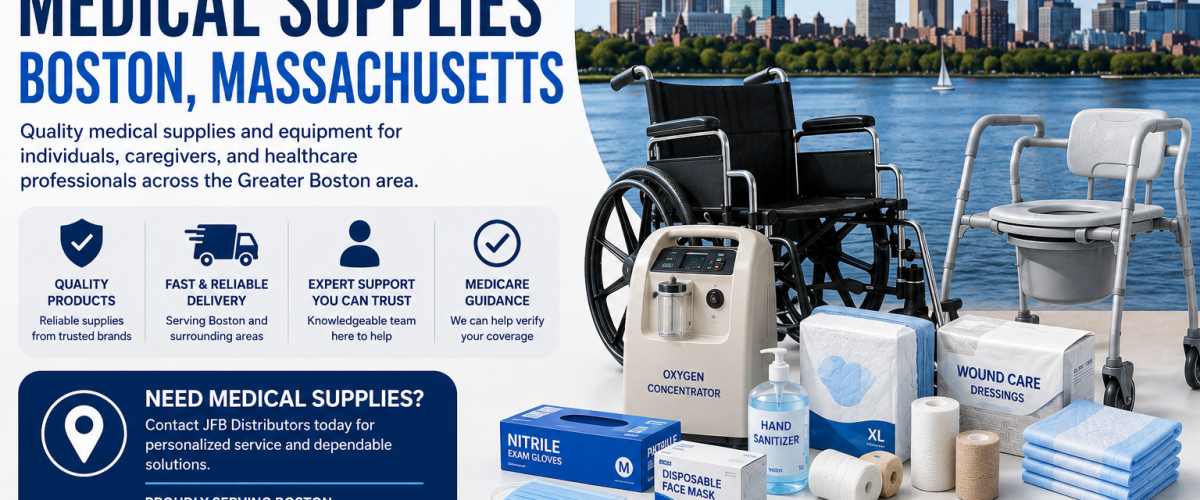
Medical supplies in Boston, MA can be sourced from local and regional medical equipment providers, pharmacies, specialty suppliers, and online distributors; the best choice depends on the exact product, clinical need, delivery requirements, payer rules, and support required.
Boston residents can obtain medical supplies from pharmacies, medical equipment companies, specialty suppliers, hospital affiliated programs, and regional distributors. The right source depends on whether the buyer needs a disposable supply, a mobility product, respiratory equipment, a hospital bed, incontinence products, or another type of home medical equipment. JFB Distributors and Delivery Services is a Massachusetts based option with a Tewksbury location and an online catalog that includes several categories of medical products.
The Boston market is large enough to support many supplier options. A current provider directory lists numerous durable medical equipment and medical supply organizations in Boston, while local businesses also serve surrounding neighborhoods. That means buyers should compare more than price. Delivery, fit, documentation, product compatibility, insurance participation, service responsiveness, and after purchase support can matter just as much.
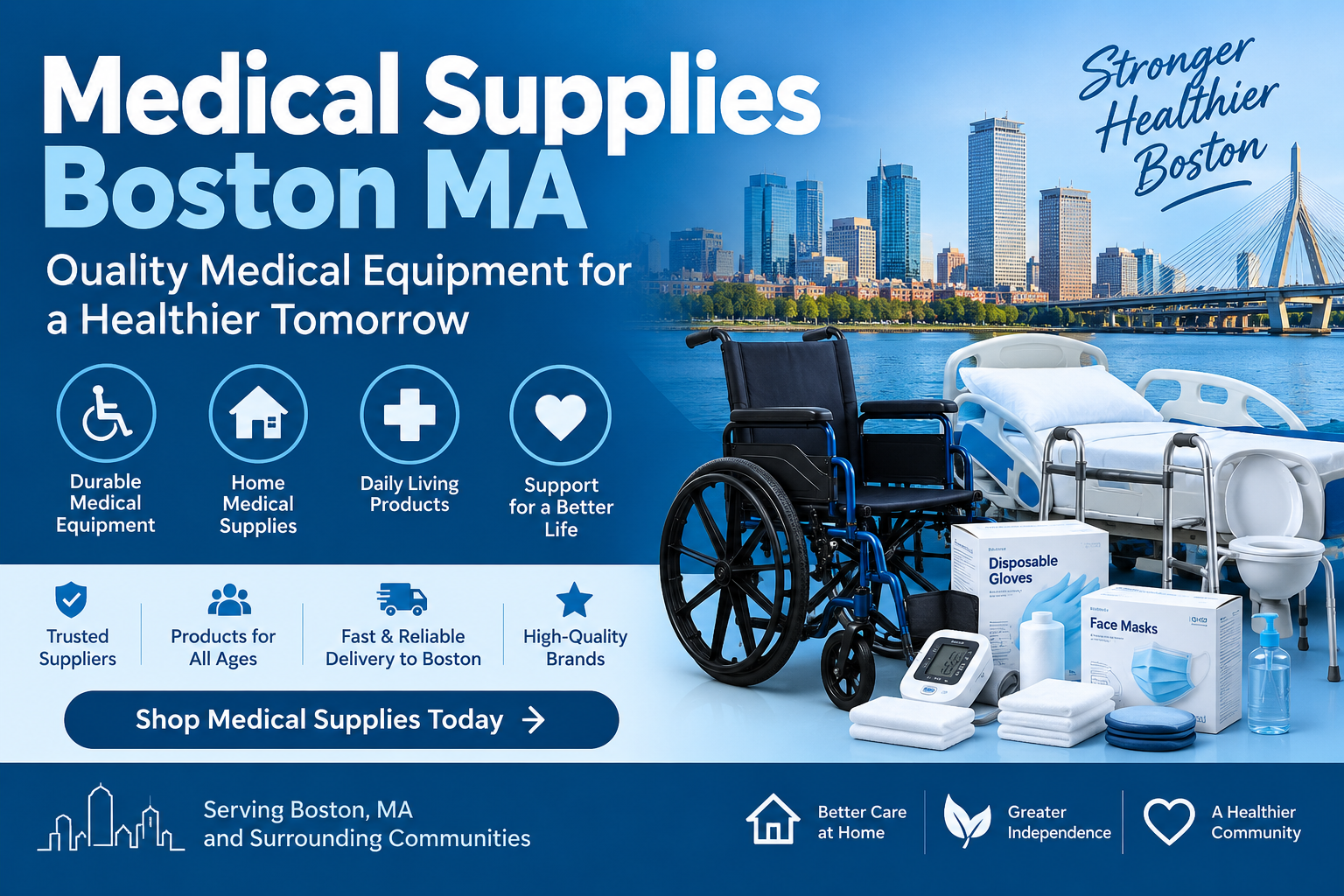
Medical supplies cover a broad range of products used for treatment, recovery, mobility, monitoring, personal care, and daily living. The category includes disposable supplies as well as durable medical equipment that is designed for repeated use.
CMS defines durable medical equipment as equipment that meets specific conditions, including repeated use, a medical purpose, an expected useful life of at least three years for items classified after January 1, 2012, and suitability for use in the home.
| Category | Examples | Important buying questions |
| Mobility | Canes, walkers, rollators, wheelchairs | Does the product fit the user and home? |
| Beds | Hospital beds, mattresses, bed accessories | What size, weight capacity, and setup are required? |
| Bathroom safety | Shower chairs, commodes, transfer aids | Can the equipment be used safely in the available space? |
| Incontinence | Briefs, protective underwear, wipes | What size, absorbency, skin-care needs, and quantity are appropriate? |
| Respiratory | CPAP/BiPAP related products and respiratory equipment | Is a prescription or clinical order required? |
| Diabetes | Glucose monitors, test strips, lancets | Is the device compatible with the required supplies? |
| Wound care | Dressings, gauze, cleansing products | Does the item match the care plan? |
| Ostomy and urological | Pouches, catheters, related supplies | Are the product type and dimensions correct? |
| Patient care | Suction supplies, lifts, positioning products | What clinical instructions and support are required? |
The best medical supply company is the one that can provide the required product safely, accurately, and within the buyer’s practical timeline. Buyers should compare product availability, delivery, documentation, insurance participation, technical support, and after sales service rather than choosing solely on price.
Boston has a competitive medical equipment market. One current provider directory identifies 75 durable medical equipment and medical supply suppliers in Boston, although directory counts can change and should not be treated as a complete official census of every supplier. Source: https://providerwire.com/durable-medical-equipment-and-medical-supplies/massachusetts/boston
| Factor | Why it matters | What to verify |
| Product fit | Incorrect equipment can be unsafe or unusable | Measurements, size, capacity |
| Availability | Prevents avoidable delays | Stock or lead time |
| Delivery | Medical needs may be time sensitive | Area, schedule, cost |
| Documentation | Some products require clinical paperwork | Prescription or medical necessity |
| Coverage | Insurance rules can change the final cost | Payer participation and authorization |
| Setup | Equipment may need assembly or adjustment | Installation and training |
| Support | Users may need help after delivery | Repairs, replacements, troubleshooting |
| Returns | Some items cannot be returned once opened | Written return policy |
Common home care equipment includes walkers, wheelchairs, hospital beds, commodes, bathroom safety equipment, and other assistive devices. The correct product depends on the user’s medical condition, mobility level, home environment, and instructions from healthcare professionals.
Medicare’s official DME description includes examples such as canes, commode chairs, CPAP therapy, crutches, glucose monitors and related supplies, hospital beds, infusion pumps and supplies, oxygen equipment, respiratory assist devices, walkers, and wheelchairs or scooters. Source: https://www.medicare.gov/coverage/durable-medical-equipment-dme-coverage
Mobility products should be selected for the person’s height, weight, strength, balance, transfer ability, and environment. A rollator may be useful for someone who can walk but needs stability and a place to rest. A wheelchair may be more appropriate when walking is not practical or safe for longer distances.
JFB Distributors lists products such as a Viper Plus reclining wheelchair and an aluminum folding walker with wheels and a seat. The listed walker has a 300 pound weight capacity, while the listed wheelchair has adjustable features designed for positioning and support. These product specifications illustrate why buyers should review model details rather than selecting a device by category name alone. Sources: https://jfbdistributors.com/products/viper-plus-reclining-wheelchair/ ; https://jfbdistributors.com/products/aluminum-dual-release-folding-walker-w-wheels-seat-29-38-inch/
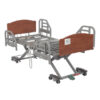
Hospital style beds can support positioning, transfers, caregiver access, and recovery. JFB Distributors lists a Prime Care Bed with a 600 pound capacity and a Delta Ultra Light 1000 semi electric bed with a 450 pound capacity. These are product specific specifications, not a recommendation that either model is appropriate for a particular patient. Sources: https://jfbdistributors.com/products/prime-care-bed-600-lbs/ ; https://jfbdistributors.com/products/delta-ultra-light-1000-semi-electric-bed/
Before ordering a bed, check:
Bathroom equipment can reduce barriers to daily activities, but safe selection requires attention to dimensions and stability. Products can include commodes, shower chairs, bath benches, raised toilet equipment, and transfer aids.
JFB Distributors lists a bariatric folding commode with a stated 650 pound capacity. A capacity rating is only one selection factor. Buyers should also consider seat dimensions, transfer method, bathroom layout, and the user’s ability to sit and stand safely. Source: https://jfbdistributors.com/products/bariatric-folding-commode/
Incontinence products are recurring supplies rather than one time purchases. Buyers should match the product to the user’s size, absorbency needs, skin sensitivity, wearing pattern, and change frequency.
JFB Distributors lists adult briefs, protective underwear, and adult cleansing wipes. For example, its catalog lists Prevail Per Fit 360 briefs, TENA Dry Comfort protective underwear, and BodyMed adult incontinence washcloths. Product sizes, pack quantities, and prices should be confirmed at the time of purchase.
Some users need specialized products such as suction canisters, ostomy supplies, respiratory accessories, or wound care products. These products require extra attention to compatibility and clinical instructions. JFB Distributors lists a McKesson 1200 mL disposable suction canister as one example of a specialized medical supply. Source: https://jfbdistributors.com/products/suction-canister-mckesson-1200-ml-pour-lid/
The central rule is simple: select equipment based on the user’s actual care requirement, not just the product’s popularity or advertised features.
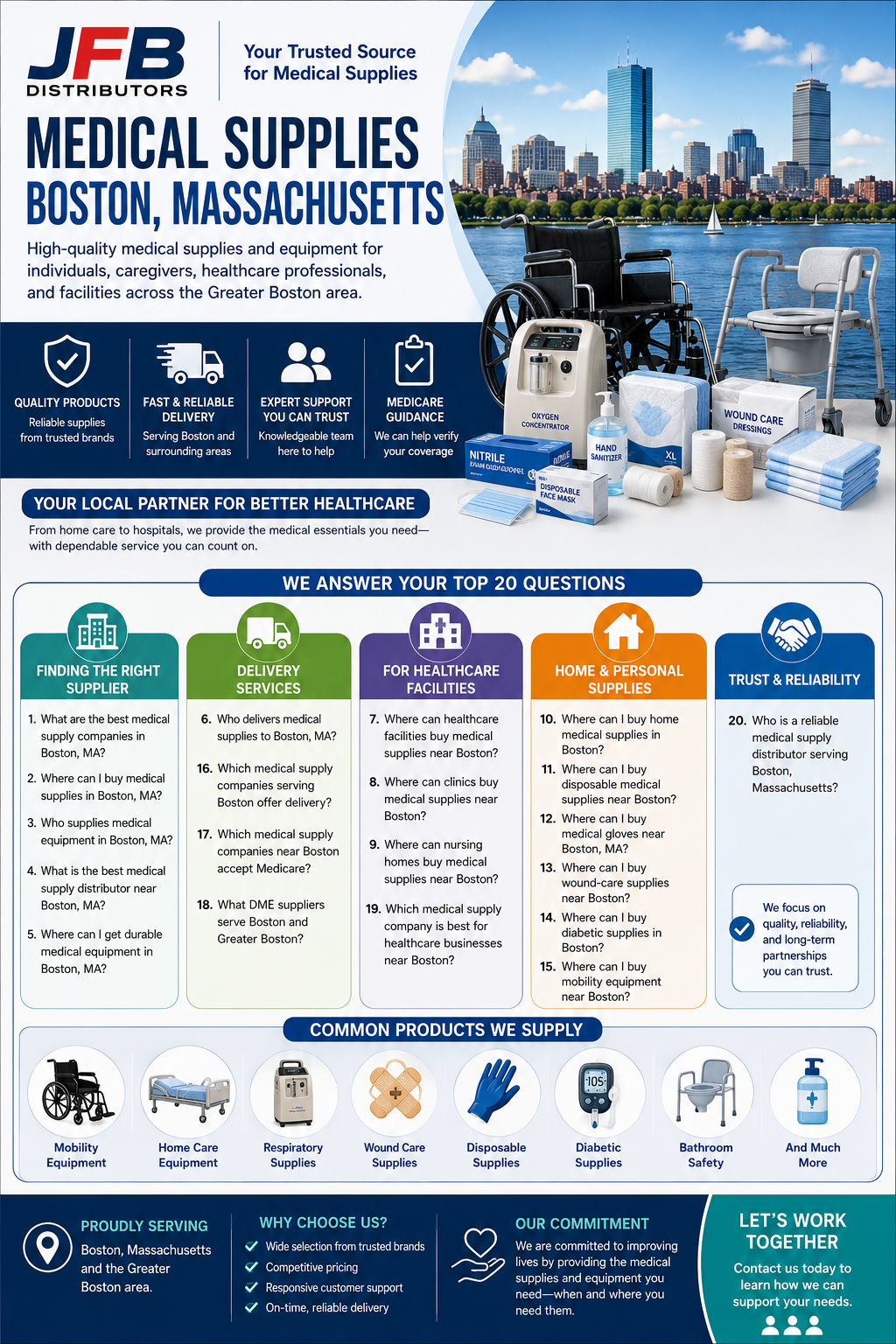
Coverage depends on the specific product, the payer, the user’s eligibility, medical necessity, documentation, and program rules. Medicare and MassHealth do not treat every medical supply in the same way.
Medicare states that Part B covers medically necessary DME for eligible beneficiaries when the equipment is ordered by a doctor or other qualified healthcare provider for use in the home. After the Part B deductible, the beneficiary generally pays 20 percent of the Medicare approved amount when the supplier accepts assignment. Source: https://www.medicare.gov/coverage/durable-medical-equipment-dme-coverage
Medicare also states that common medical supplies used at home, such as ordinary bandages and gauze, generally are not covered under its standard supplies benefit. Source: https://www.medicare.gov/coverage/supplies
MassHealth publishes specific guidance for medical equipment and supplies. Its member information lists examples including briefs, diapers, pull ups, crutches, canes, walkers, wheelchairs, formula and tube feeding supplies, diabetic supplies, ostomy and catheter supplies, oxygen equipment, CPAP/BiPAP, home ventilators, and tracheostomy equipment.
Source: https://www.mass.gov/medical-equipment-and-supplies-for-masshealth-members
MassHealth also explains that a provider may recommend or order DME, and that a DME provider may require a prescription or letter of medical necessity. Many DME items require prior authorization, and the DME provider coordinates delivery after the necessary documentation or authorization is obtained. Source: https://www.mass.gov/info-details/durable-medical-equipment-for-masshealth-members
The safest approach is to verify coverage before placing an order. Ask the supplier and payer which documents are required, whether the supplier participates in the relevant program, and what portion of the cost is the buyer’s responsibility.
| Question | Medicare | MassHealth |
| Is every medical supply covered? | No | No |
| Can documentation matter? | Yes | Yes |
| Can medical necessity matter? | Yes | Yes |
| Can supplier requirements matter? | Yes | Yes |
| Can prior authorization apply? | Depends on benefit and item | Many DME items require it |
| Should buyers verify coverage before purchase? | Yes | Yes |
Medical supply delivery normally begins with product identification, availability confirmation, documentation review when needed, payment or coverage arrangements, and scheduling. Large equipment may also require delivery access planning and setup.
Delivery is especially important for products used after surgery, during rehabilitation, or for ongoing home care. A supplier should be able to explain whether the delivery is curbside, room of choice, assembled, fitted, or accompanied by user instruction.
MassHealth explicitly states that the DME provider coordinates delivery after required documentation or prior authorization is obtained. Source: https://www.mass.gov/info-details/durable-medical-equipment-for-masshealth-members
JFB Distributors’ contact page provides a phone number, email, and Tewksbury address for inquiries. Customers should use the official contact page to confirm current delivery areas, product availability, pricing, and service terms rather than relying on old listings.
Source: https://jfbdistributors.com/contact-us/
JFB Distributors and Delivery Services is a Massachusetts based medical supply company with a Tewksbury location and an online catalog of medical equipment and supplies. Its official contact page lists 853 Main St #205, Tewksbury, Massachusetts 01876, phone 617-502-0784, and jfbdistributors@outlook.com.
Source: https://jfbdistributors.com/contact-us/
A regional supplier can be useful when a Boston customer wants to discuss a product before ordering, confirm delivery, or compare equipment specifications. JFB’s catalog provides examples across several categories, including beds, wheelchairs, walkers, incontinence products, commodes, and specialized supplies.
The table uses product information published by JFB’s online catalog. It does not mean every product is appropriate for every user. Product selection should consider medical instructions, fit, safety, payer requirements, and the user’s circumstances.
| Product example | Category | Published specification or feature |
| Prime Care Bed | Bed / medical supply | Listed 600 lb weight capacity |
| Delta Ultra Light 1000 | Semi electric bed | Listed 450 lb weight capacity |
| Viper Plus Reclining Wheelchair | Mobility | Reclining mechanism and adjustable features |
| Aluminum Folding Walker | Mobility | Listed 300 lb weight capacity |
| Bariatric Folding Commode | Bathroom / medical supply | Listed 650 lb weight capacity |
| Prevail Per Fit 360 Brief | Incontinence | Listed heavy absorbency |
| BodyMed Adult Washcloths | Personal care | 48 wipes per package |
| McKesson Suction Canister | Suction / drainage | 1200 mL disposable canister |
Boston buyers should compare suppliers using a consistent checklist that covers product suitability, availability, delivery, documentation, coverage, price, and support. A structured comparison reduces the chance of selecting a product that is unavailable, unsuitable, or unexpectedly expensive.
You can buy medical supplies from pharmacies, local medical equipment companies, specialty suppliers, and regional distributors. The right source depends on the product and whether you need delivery, setup, insurance processing, or technical support. JFB Distributors is a Massachusetts based supplier with a Tewksbury location and an online catalog. Confirm current product availability and Boston delivery options directly with the supplier.
Medicare coverage depends on the type of item and whether it qualifies under a covered benefit. Medicare Part B covers medically necessary durable medical equipment when eligibility and ordering requirements are met. Medicare also states that many ordinary household supplies, including common bandages and gauze, are generally not covered under the standard medical supplies benefit.
MassHealth covers certain durable medical equipment and supplies for eligible members, subject to program requirements. MassHealth explains that some items require a prescription or letter of medical necessity and that many DME items require prior authorization. Coverage and authorization should be confirmed before purchase.
Many suppliers offer delivery, but service areas, fees, scheduling, setup, and equipment requirements vary. For large equipment, the supplier may need information about stairs, elevators, doorways, and room dimensions. Ask the supplier to confirm the delivery method and expected timing before placing an order.
The answer depends on the parent’s condition and care plan. Common categories can include mobility aids, bathroom safety equipment, incontinence products, beds, positioning equipment, and other home care supplies. Ask the healthcare team what is clinically appropriate, then confirm product size, capacity, compatibility, and delivery requirements with the supplier.
Choose mobility equipment based on the user’s height, weight, strength, balance, transfer ability, home layout, and intended use. Weight capacity and dimensions are important, but they are not the only factors. A clinician, therapist, or qualified equipment professional can help determine whether a specific model fits the user’s needs.
JFB Distributors’ official contact page lists 853 Main St #205, Tewksbury, Massachusetts 01876, phone 617-502-0784, and jfbdistributors@outlook.com. Use the official contact page to ask about current inventory, delivery, pricing, documentation, and service terms.
The appropriate home supply list depends on the person’s health needs. A general list might include prescribed monitoring supplies, wound care products, mobility aids, bathroom safety equipment, personal care products, and required replacement accessories. Avoid stocking specialized medical products solely because they are popular; use the care plan and supplier guidance to select the right products.
Choosing medical supplies in Boston, MA is easier when the buyer starts with the exact healthcare need and then checks product fit, documentation, coverage, delivery, and ongoing support. Medicare and MassHealth rules can differ, so buyers should verify coverage and authorization requirements before committing to a purchase.
JFB Distributors and Delivery Services provides a regional Massachusetts option for buyers who want to ask about medical equipment and supplies. Its online catalog includes mobility products, beds, incontinence supplies, commodes, and other medical products, while its official contact page provides a direct way to request current information.
For Boston residents, caregivers, and organizations, the most useful next step is to identify the exact product, confirm the required specifications and documentation, and ask the supplier to verify current availability and delivery.
Call to action: Contact JFB Distributors and Delivery Services through the official contact page to discuss your medical supply or home medical equipment needs, confirm current availability, and ask about delivery to Boston: https://jfbdistributors.com/contact-us/